Milton Keynes must improve access to investment, strengthen its talent pipeline and bring its technology businesses closer together if it is to fulfil its ambitions as an innovation centre, according to findings from an MK Tech Week workshop.
A new assessment of the Milton Keynes innovation ecosystem, conducted by Whitecap Consulting during MK Tech Week 2026, identified significant weaknesses in access to capital, collaboration and the development of skilled talent.
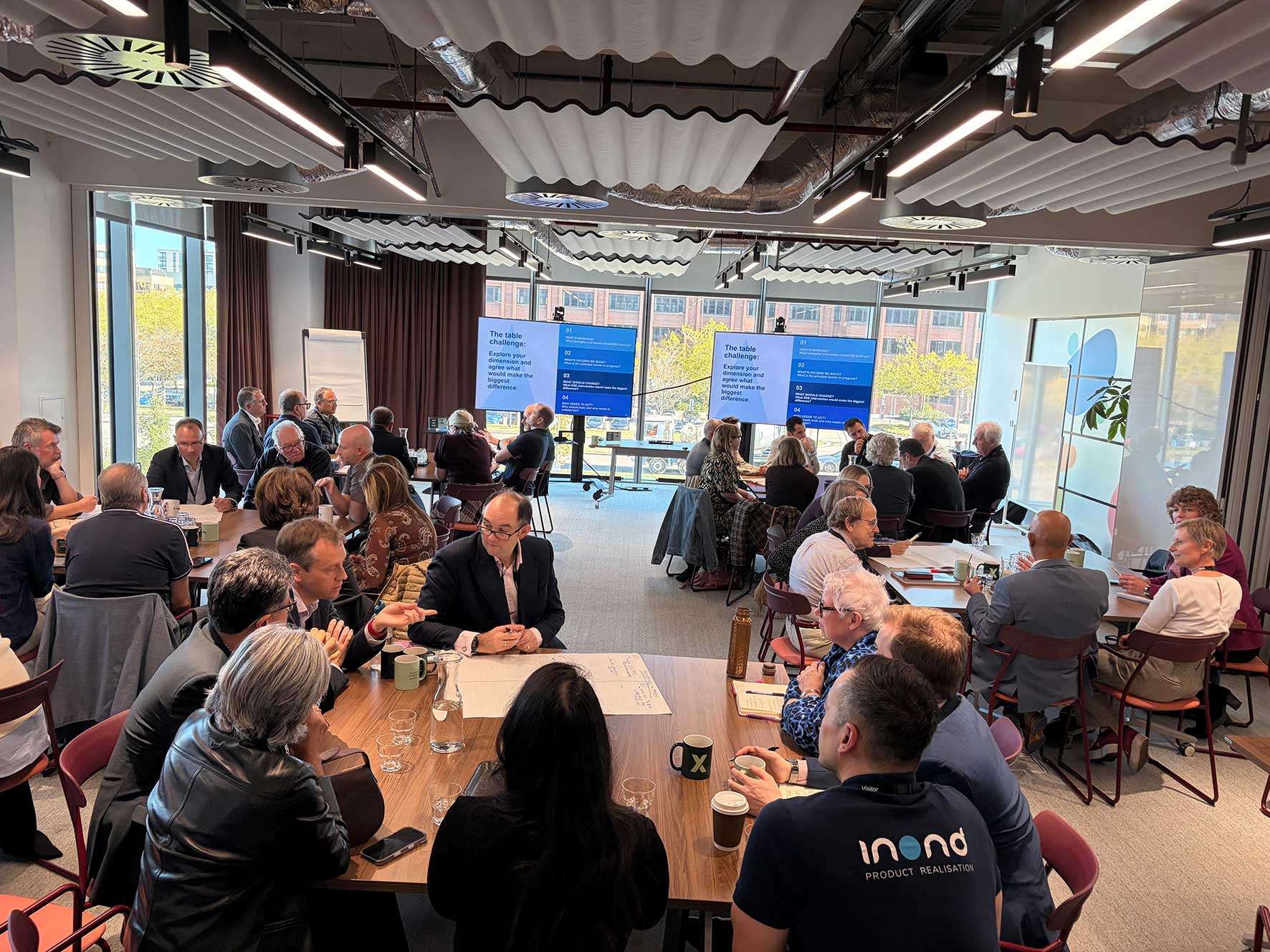
The workshop brought together representatives from across the city’s technology and innovation community to assess its strengths, identify barriers to growth and consider what needs to change.
Participants scored six areas of the city’s innovation ecosystem on a scale of one to five, with five representing the most advanced level of development.
Access to capital and funding received the lowest score at just 1.5 out of five, followed by talent and community building at 1.8. Collaboration between industry clusters and partners scored 2.4.
By comparison, Milton Keynes performed more strongly on its overall ambition and vision, scoring 3.0, while infrastructure and placemaking, and diversity and inclusion, each received 2.9.
The findings suggest that while Milton Keynes has many of the ingredients needed to support a successful technology economy, businesses and organisations are not yet sufficiently connected to make full use of them.
Limited access to venture capital and private equity, fragmented public funding programmes and a shortage of visible investment opportunities were among the concerns raised.
Participants also questioned whether the city’s substantial corporate presence was doing enough to support smaller businesses through procurement opportunities, commercial trials and access to customers.
The workshop identified the need for stronger links between employers and education providers, including Cranfield University, Milton Keynes College and The Open University, to improve skills development and create clearer routes into the technology sector.
The loss of the proposed MK University campus was also cited as a continuing gap in the city’s talent pipeline.
Despite its established technology businesses, transport connections and position within the Oxford-Cambridge growth corridor, Milton Keynes was described as lacking a sufficiently visible and unified technology identity.
Participants highlighted the city’s dispersed business locations as another obstacle, reducing opportunities for informal networking and collaboration.
The report recommends developing a shared vision for the city’s innovation economy, identifying two or three distinctive strengths and agreeing measurable outcomes to be achieved by the end of 2027.
It also calls for more regular networking between entrepreneurs, investors, employers and education providers, rather than relying on major events to maintain momentum.
Whitecap Consulting director Lal Tawney, who circulated the findings following the workshop, said Milton Keynes already possessed many of the ingredients of a strong innovation ecosystem.
“The opportunity now is to connect them around a clearer shared purpose and turn that ambition into more visible, year-round activity,” he said.
The report includes a separate contribution from Protospace, the not-for-profit organisation behind MK Tech Week, outlining existing initiatives aimed at addressing some of the challenges.
These include the Technology and Innovation Leadership Roundtable, established in collaboration with Milton Keynes City Council, and activities such as MK Geek Night, The Founders Circle and the Protospace Digital Hub.
Protospace also highlighted the Innovation Circuit, a regional programme led by The Open University and supported by up to £20 million through the government’s Local Innovation Partnerships Fund.
The programme aims to bring research institutions, businesses and local authorities together to accelerate the commercial development of technologies, including connected and autonomous systems, high-performance engineering and space-related innovation.
Protospace said it would incorporate the workshop findings into its planning for 2027 and share them with Milton Keynes City Council and other partners.
The workshop conclusions are based on the views of participants rather than a representative survey of the city’s business community. Between 40 and 43 responses were received for each scored category.
Nevertheless, the findings point to a central challenge for Milton Keynes: translating its established reputation for innovation into stronger commercial relationships, improved access to finance and more visible opportunities for business growth.
Pictured: Participants at the Whitecap Consulting innovation ecosystem workshop, held during MK Tech Week 2026, discussed barriers to investment, skills development and collaboration.