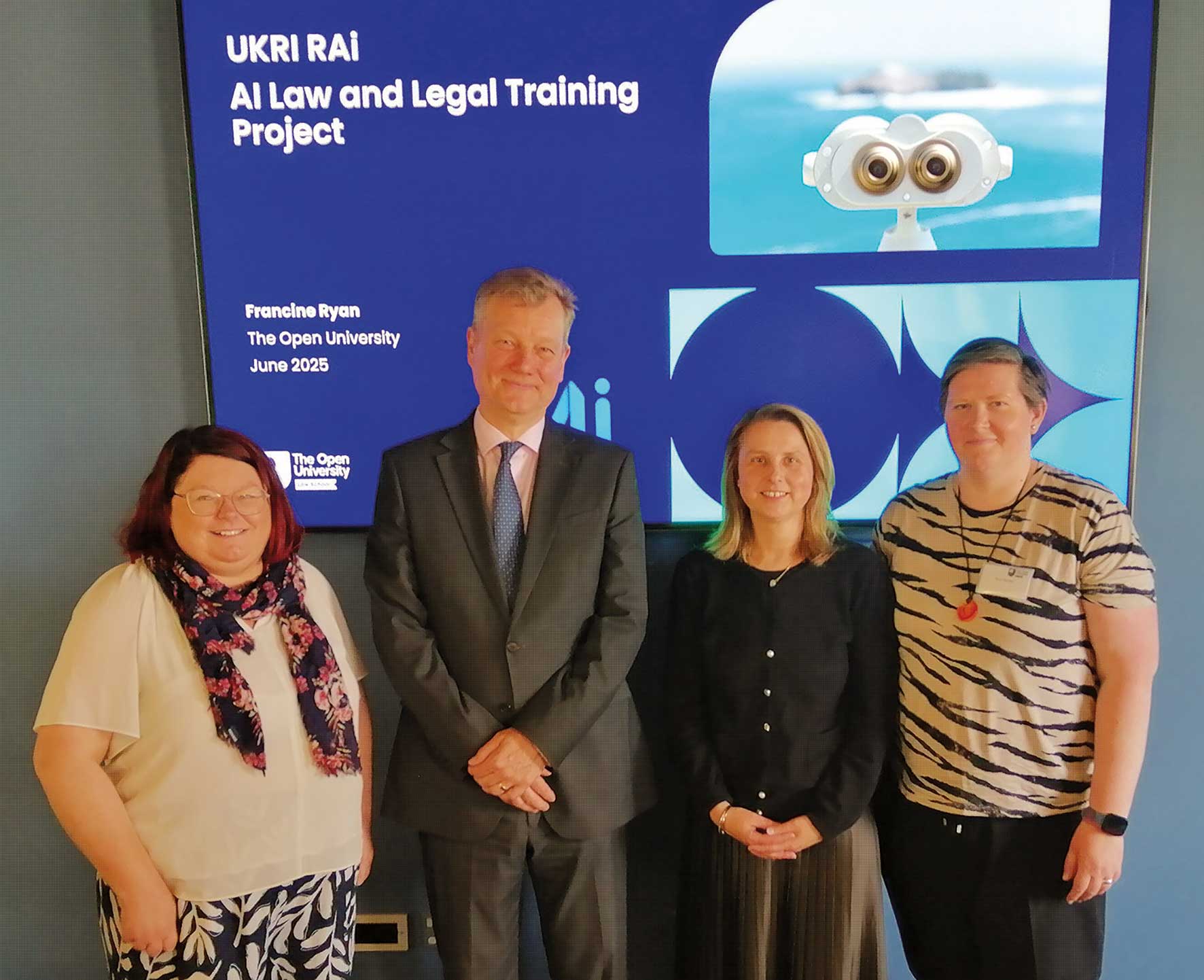
Pictured: Lord Justice Birss with some of the project team (from left) Liz Hardie, Dr Francine Ryan and Professor Kim Barker

Professor Hugh McFaul, head of The Open University Law School, discusses research-informed resources about using artificial intelligence in a legal context.
An urgent need to provide trusted information on how to use artificial intelligence properly in legal settings is behind the launch of our free new courses. With the rise of Generative AI, we are seeing more and more lawyers use tech tools to support their work, not to mention members of the public – many without access to professional legal support – opting to rely on them. This represents a significant risk. It is clear, across the sector, that there is a growing need for help as GenAI brings both opportunity and huge change amid a myriad of ethical challenges. Our first-of-its kind suite of free resources aims to both embrace AI and recognise its drawbacks.

The AI, Law and Legal Training project is a collaboration with the University of Lincoln and Citizens Advice, which supports the public with legal information and guidance in person, by phone and online. Funded by UKRI Responsible AI, a suite of research-informed free resources – developed with support from lawyers at Fieldfisher, Mishcon de Reya and Browne Jacobson – have been created to enhance the use of GenAI for understanding legal processes and accessing legal information. These eight engaging online courses will provide ethical and responsible knowledge of – and skills to use – GenAI. The 20 hours’ interactive learning uses video and audio content, as well as quizzes, to consolidate knowledge spanning:
-
An introduction to GenAI including its advantages and limitations.
-
Key concerns to be aware of, particularly when using GenAI for legal queries.
-
An exploration of how GenAI can be used in a legal context and considerations on how to use it responsibly (with examples of where things can go wrong).
My colleague Dr Francine Ryan, lead researcher and director of our Open Justice Centre, said: “These will help educate and empower a wide audience including the public, legal advice organisations, small and medium firms, students and academics. It will explain GenAI, its application, implications and ethical use in legal contexts. “There is a significant risk of societal harm if we do not build capacity on how to use GenAI ethically and responsibly. Lack of access to legal advice often causes disadvantage and trusted resources and education on GenAI within law are one way of mitigating existing structural inequalities.”
Lord Justice Birss delivered the keynote address to open a recent project workshop in London, speaking about his experience with AI as a judge and the potential of AI to help close the access to justice gap. His speech was followed by three panel discussions on AI and Access to Justice, AI and Legal Practice and AI and Legal Education.
Find out more about the courses here.
Get the full picture at The Open University Law School law-school.open.ac.uk
Join a new LinkedIn page dedicated to the OU Law School which aims to showcase our student stories, research, events, qualifications and courses. Please follow @the-open-university-law-school and join other legal employers, industry experts and policymakers, as well as our own students, alumni and academic colleagues.