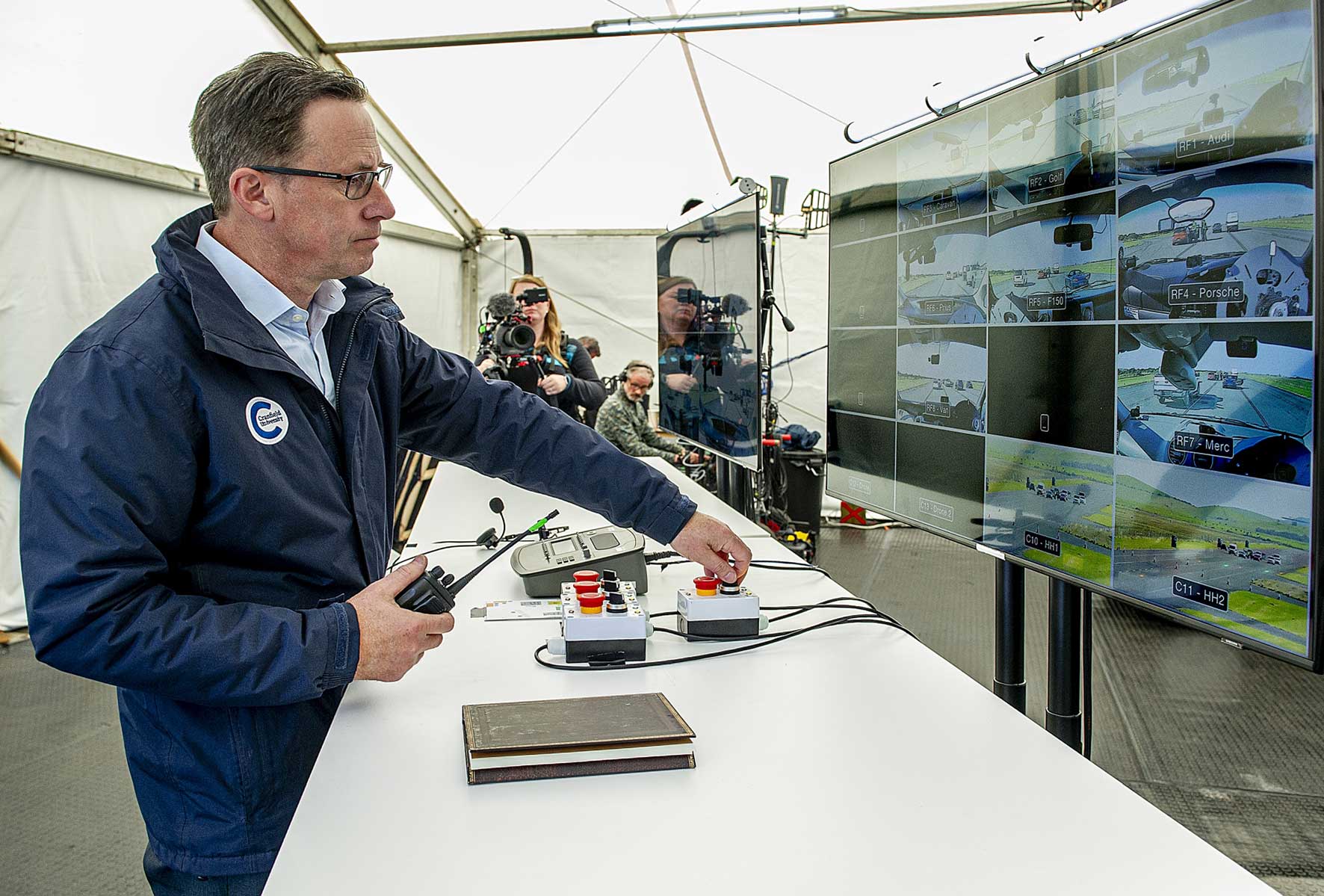
Professor James Brighton in the experiment control centre. Image: Cranfield University
Cranfield University has played a central role in one of the most ambitious road safety experiments ever broadcast on British television, contributing its engineering expertise to a simulated motorway pile-up involving eight vehicles, a 30-tonne lorry and more than 90 cameras.
Commissioned by Channel 4 and produced by Blink Films, Pile Up – The World’s Biggest Crash Test aired on 15 June and provided unprecedented insight into the dynamics of multi-vehicle motorway collisions — which remain among the least understood road traffic incidents.
According to official statistics, nearly 20% of all motorists killed on British roads die in crashes involving three or more vehicles. In 2022 alone, nearly 800 car occupants died and over 74,000 were injured, while someone is killed or seriously hurt every 17 minutes.
Despite the severity of these incidents, research into the causes and consequences of pile-ups remains limited. Investigators typically arrive post-crash, relying on scattered evidence to piece together what happened. This experiment allowed scientists to observe the event in real time — capturing detailed crash data, vehicle telemetry and driver behaviour.
At the heart of the project was Professor James Brighton of Cranfield University’s Advanced Vehicle Engineering Centre. Brighton and his team spent months designing a realistic, high-speed motorway collision scenario, deploying cutting-edge remote driving technology to stage the crash safely at a former RAF base in Scotland.
“There could be no second takes,” said Professor Brighton. “This was a unique opportunity to study a real-world crash scenario in extraordinary detail — from the timing of driver reactions to the resilience of modern safety systems. It’s data we’re now incorporating into our MSc courses to help shape the next generation of automotive engineers.”
Eight distinctly different vehicles — from a Toyota Prius and Porsche Boxster to a Ford F-150 and Mercedes ML — were fitted with black box recorders and driven via remote-control pods by a mix of researchers and unknowing members of the public, each selected to represent different driver demographics.
Their genuine reactions were captured as a lorry, travelling in the opposite direction, swerved into their lane, triggering a violent chain-reaction crash.
Among the participants was 19-year-old Caitlyn, a healthcare assistant from Liverpool representing Britain’s 2.8 million young drivers, and Luke, 26, a self-professed “adrenaline junkie” from Brighton. Others included Lynn, a 66-year-old grandmother from Rochdale, and Tito, a 57-year-old surfer living in Glasgow. None had been told in advance what would unfold.
The experiment revealed several key findings:
-
Crumple zones save lives: The Prius’s battery pack remained intact despite a rear-end shunt, thanks to effective crumple design.
-
Airbags are not infallible: In some instances, they failed to deploy depending on the point of impact.
-
Safety systems struggle under multiple impacts: Once deployed, features like airbags and crumple zones lose effectiveness in repeated collisions.
-
High driving positions aid visibility: Drivers in taller vehicles responded earlier to the unfolding crash.
-
The hard shoulder is dangerous: Occupants in vehicles stopped there would likely not have survived.
-
Human reactions are unpredictable: One participant, after safely stopping, panicked and accelerated into the crash.
US crash expert Dr Janet Bahouth, who analysed the footage, said: “My main interest is how vehicle damage affects survivability. You can’t make an airbag deploy twice — that’s one of the major limitations in multi-impact crashes.”
The experiment also tested the reliability of crash forensic analysis. Marcus Rowe, an experienced investigator, was able to piece together the event without having seen it unfold — including the highly unusual case of a car ending up beneath the lorry.
While the findings cannot be generalised from a single event, the data gathered is expected to inform future vehicle design, safety research and driver education.
Pile Up – The World’s Biggest Crash Test aired on Channel 4 on 15 June.