Businesses risk spending money on AI adoption without improving how they work unless they tackle specific problems and measure the results, speakers told more than 300 attendees at Milton Keynes’ Accelerating AI Conference.
The gap between experimenting with technology and securing a business benefit dominated discussions at Unity Place on Tuesday, October 13. Held as part of Milton Keynes Tech Week, the conference examined how employers can turn growing familiarity with AI into better customer service, reduced administration and capacity for growth.
Research presented by NatWest’s Debbie Lewis illustrated the challenge. While 44% of 1,400 surveyed SMEs and mid-market businesses already use AI, only 6% of current users have reached the stage where it fundamentally changes how their organisations operate.
Access to software was only part of the answer. Businesses also needed to understand where it could improve a service, remove a bottleneck or give employees more time for work requiring their expertise.
“The businesses that get the most from AI won’t be the ones that use more of it,” Debbie said. “They’ll be the ones that use it to solve real customer problems.”
That distinction ran through the practical examples discussed during the day. A regional engineering business supported by South Midlands Growth Hub initially approached the organisation wanting to “do something with AI”. Further investigation found that its engineers were spending hundreds of hours a month searching technical documents and previous projects.
The business could then test a specific proposition: whether an AI-powered knowledge system could reduce that searching time by 20%. The figure was a target for the experiment, rather than a reported saving.
Defining the problem gave the company a basis for assessing the technology before committing to a wider programme.
Sam Hunter of South Midlands Growth Hub urged delegates to take the same approach, establishing the value of a problem, the safeguards required and the smallest useful test they could run.
“You don’t need to understand every new AI model,” Sam said. “You don’t need to predict where the technology’s going to be in three years. You just need to identify a problem worth solving and test whether AI can help you.”
The approach also raised a question for businesses considering investment: whether they needed AI at all.
Lucy Pittas-rothwell of FreeAgent distinguished between tasks that benefit from AI and those that can be handled through conventional automation. Chasing an overdue invoice, for example, may require an automated reminder rather than a language model.
Her examples of handling receipts, categorising transactions and preparing quotations showed how improvements could begin with routine administration. Connecting tools to business information could reduce the need to copy details between systems, although greater access also brought additional responsibilities.
Those responsibilities become more significant as businesses move from asking AI questions to allowing agents to carry out work.
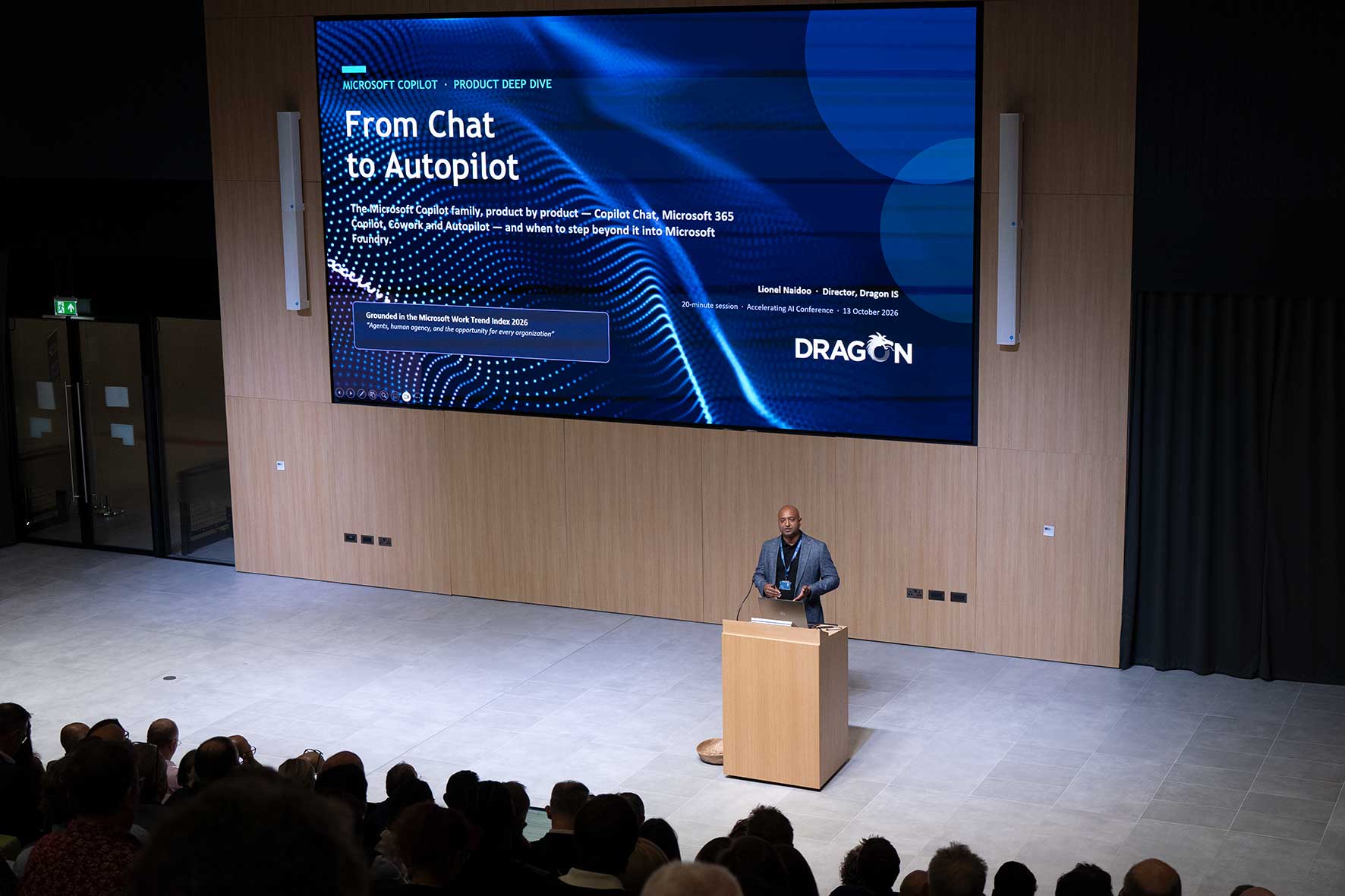
Lionel Naidoo of Dragon Information Systems explored systems capable of assembling reports, preparing customer information and coordinating tasks across applications. The potential benefit was the ability to delegate an outcome, rather than repeatedly instruct a tool through each step.
However, the discussion placed as much emphasis on control as capability. Businesses needed to know which information an agent could access, what actions it could take, how much its work cost and who would check the result.
Lionel described agent identities and permissions as a way to apply the principles already used to manage employees’ access to business information. A system carrying out marketing work, for example, should have access appropriate to that role.
The need for safeguards extended beyond permissions. Richard Morrison-Butcher of South East CRC highlighted phishing, the financial and reputational consequences of cyber incidents, and the difficulties smaller organisations can face in detecting and responding to attacks.
Meanwhile, Ed Braund of the University of Bedfordshire examined why the behaviour of interacting agents needs to be assessed over time. Research discussed in his presentation used controlled simulations to explore how extended autonomy could produce unexpected outcomes. The findings were explicitly presented as simulated behaviour, rather than a reliable ranking of model safety.
His wider argument was that adoption requires organisations to examine their processes and train their people. Adding technology to an inefficient way of working does not automatically resolve the underlying problem.
Customer expectations provided another reason to retain human involvement. NatWest’s research found that 81% of retail customers surveyed regarded access to a real person when needed as the most important trust factor.
“The opportunity here is to combine what AI is capable of doing with human expertise and judgement to make customer relationships more useful, more personal and more responsive,” Debbie said.
The same issue arose in the discussion of marketing and design. Lorna Bladen of Canva encouraged businesses to use AI to accelerate production and explore ideas, while continuing to check whether the resulting content reflected their brand.
Time saved could be redirected towards creative work and customer relationships. Producing more material would still require decisions about its quality, relevance and purpose.
Questions from the audience brought the commercial and operational issues together, covering return on investment, LinkedIn automation, environmental impact and the support available to businesses choosing their next step.
Speakers highlighted the importance of matching the tool to the task. A smaller model or a straightforward automation could sometimes achieve the required result at lower cost than a more complex system.
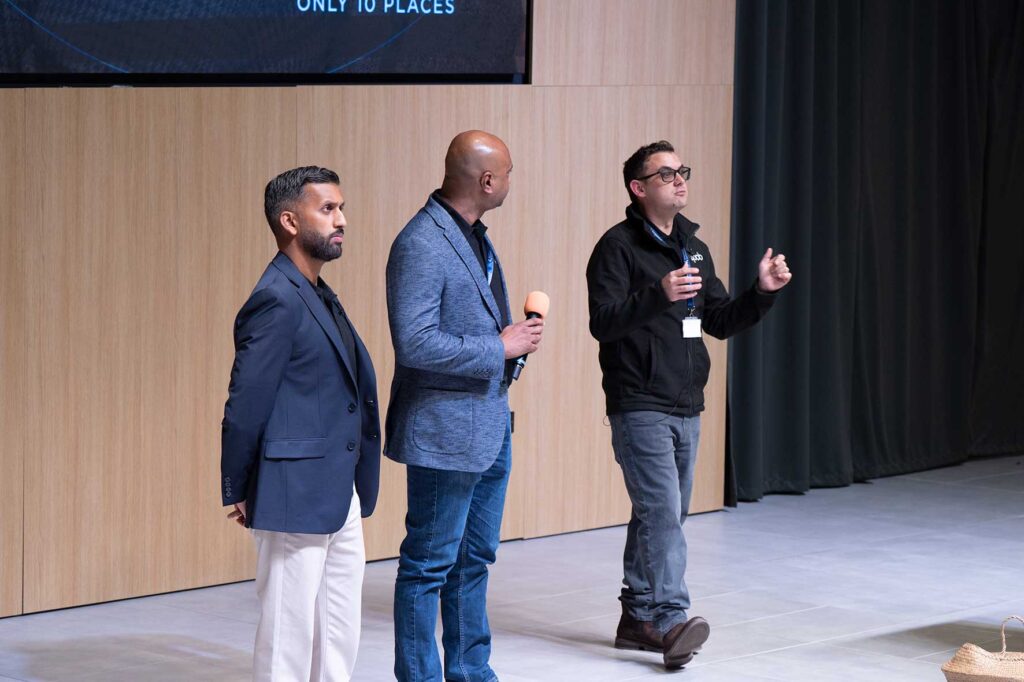
The fifth Accelerating AI Conference was organised by Matthew Rigby-White of Qoob, Lionel Naidoo of Dragon Information Systems and Andy Paul of Fliweel.tech. Business MK director Kerry Lewis-Stevenson hosted the day, with Business MK supporting Milton Keynes Tech Week as a media partner.
For businesses leaving with a long list of possible applications, Sam’s advice was to narrow their attention to something they could test.
“You don’t need every business to become an AI company,” she said.
The next Accelerating AI Conference will take place on April 15, 2027.